
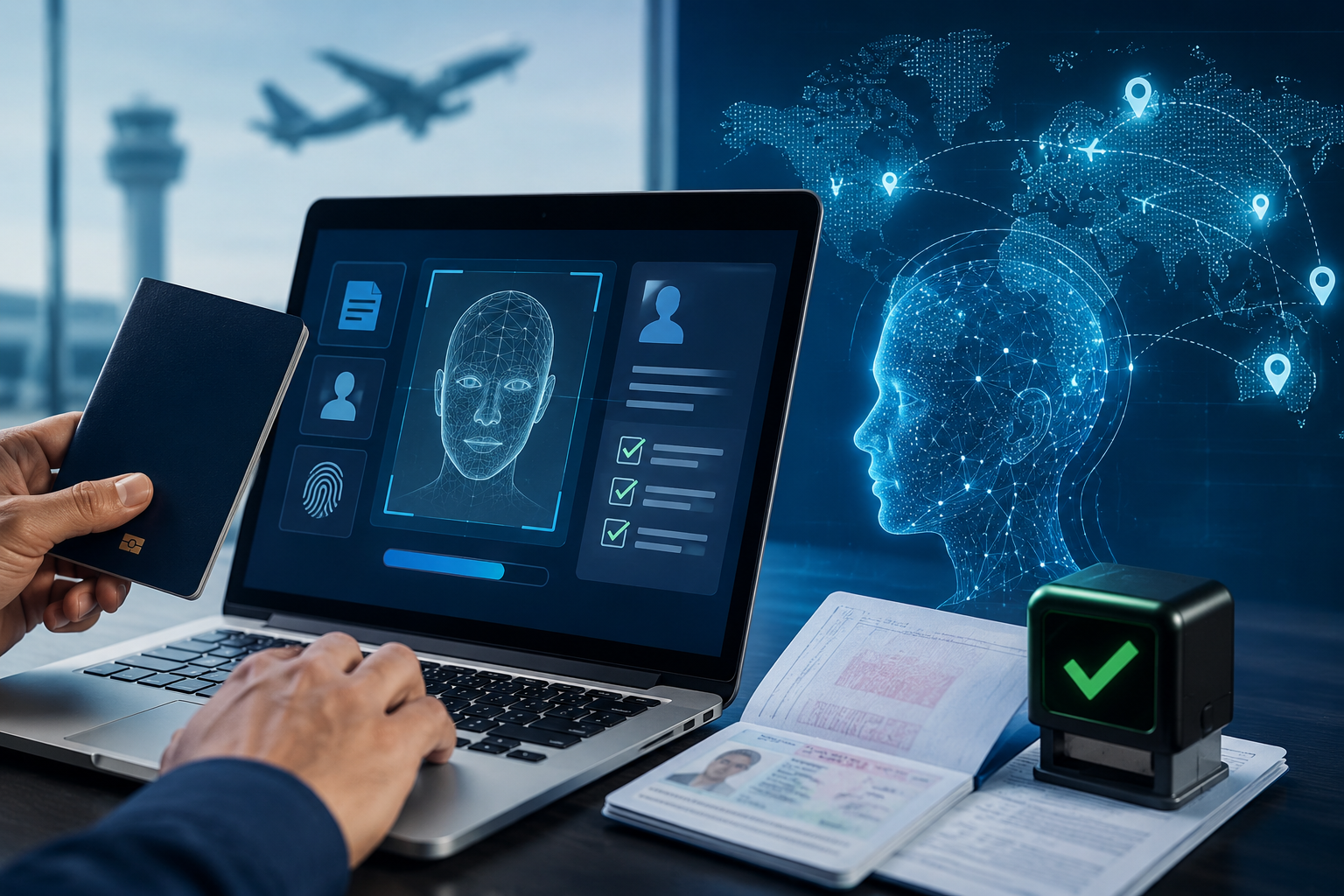
As international travel, education, employment, and business opportunities continue to grow, governments are facing increasing pressure to process visa applications quickly while maintaining high security standards. Traditional visa systems often involve extensive paperwork, manual verification, and lengthy processing times. To address these challenges, many countries are adopting artificial intelligence (AI) to modernize immigration services.
AI in visa processing is transforming how governments analyze applications, detect fraud, verify identities, and improve decision-making. While AI is making immigration systems faster and more efficient, it also raises important questions about transparency, fairness, and data privacy.
This article explores how digital immigration is evolving through AI, its benefits, challenges, real-world applications, and what applicants should expect in the future.
| Section | Description |
|---|---|
| Introduction | Understanding digital immigration |
| What Is Digital Immigration? | Definition and objectives |
| Role of AI in Visa Processing | How AI supports immigration systems |
| Technologies Used | AI tools powering modern immigration |
| Benefits | Advantages for governments and applicants |
| Challenges | Risks and ethical concerns |
| Global Examples | Countries using AI for immigration |
| Future Trends | What’s next in AI-powered immigration |
| Tips for Applicants | Preparing for AI-assisted visa systems |
| Conclusion | Final thoughts |
Digital immigration refers to the use of digital technologies to manage immigration services, including visa applications, border control, identity verification, document processing, and traveler screening.
Instead of relying solely on manual processes, immigration authorities increasingly use:
These technologies improve efficiency while maintaining national security.
AI in visa processing involves using intelligent software to assist immigration officials with reviewing applications, verifying applicant information, detecting suspicious activities, and making administrative decisions.
Rather than replacing immigration officers, AI acts as a decision-support tool by handling repetitive and data-intensive tasks.
Common AI functions include:
| Technology | Purpose | Benefits |
|---|---|---|
| Machine Learning | Learns patterns from historical visa data | Faster decision support |
| Optical Character Recognition (OCR) | Reads passports and documents | Reduces manual data entry |
| Facial Recognition | Confirms applicant identity | Improves security |
| Natural Language Processing (NLP) | Understands written information | Faster document review |
| Predictive Analytics | Identifies potential risks | Better fraud prevention |
| Robotic Process Automation (RPA) | Automates repetitive tasks | Increased efficiency |
| Biometrics | Verifies fingerprints and facial features | Strong identity protection |
| Cloud Computing | Stores and processes large datasets | Scalable immigration systems |
Traditional document verification requires officers to manually inspect passports, bank statements, educational certificates, employment letters, and travel history.
AI can:
This significantly reduces processing time.
Modern immigration systems use AI-powered facial recognition alongside biometric verification.
The system compares:
This minimizes identity fraud and improves accuracy.
Visa fraud remains a significant challenge worldwide.
AI identifies suspicious activities by analyzing:
Machine learning models continuously improve as they process more cases.
Instead of manually reviewing every application equally, AI helps authorities identify applications requiring closer examination.
Risk indicators may include:
Lower-risk applications may proceed more quickly while higher-risk cases receive additional review.
AI can organize visa applications based on urgency.
Examples include:
This improves efficiency during periods of high demand.
Many immigration departments now use AI-powered virtual assistants to answer frequently asked questions.
Common inquiries include:
Applicants receive assistance around the clock without waiting for customer service representatives.
AI-powered translation tools simplify communication for international applicants.
Benefits include:
| Benefit | Explanation |
|---|---|
| Faster Processing | Reduces waiting periods |
| Improved Accuracy | Minimizes manual errors |
| Enhanced Security | Detects fraud more effectively |
| Better Resource Management | Allows officers to focus on complex cases |
| 24/7 Support | AI chatbots assist applicants anytime |
| Cost Reduction | Automates repetitive administrative work |
| Consistency | Standardizes application reviews |
| Improved Applicant Experience | Faster responses and updates |
| Benefit | Explanation |
|---|---|
| Faster Processing | Reduces waiting periods |
| Improved Accuracy | Minimizes manual errors |
| Enhanced Security | Detects fraud more effectively |
| Better Resource Management | Allows officers to focus on complex cases |
| 24/7 Support | AI chatbots assist applicants anytime |
| Cost Reduction | Automates repetitive administrative work |
| Consistency | Standardizes application reviews |
| Improved Applicant Experience | Faster responses and updates |
Although AI offers numerous benefits, several challenges remain.
Immigration systems collect highly sensitive personal information.
Authorities must protect:
Strong cybersecurity measures are essential.
AI systems learn from historical data.
If training data contains bias, AI could unintentionally produce unfair outcomes for certain groups.
Governments must regularly evaluate AI systems to ensure fairness and accountability.
Applicants may not always understand why certain decisions are made if AI contributes to the review process.
Providing clear explanations and maintaining human oversight are important for building trust.
Immigration databases are valuable targets for cybercriminals.
Potential risks include:
Robust security practices are necessary to safeguard sensitive information.
Several countries are exploring or implementing AI-assisted immigration technologies.
| Country | AI Applications |
|---|---|
| Singapore | Smart immigration checkpoints and biometric verification |
| United Arab Emirates | AI-supported immigration services and digital identity systems |
| Canada | Digital application management and automated processing tools |
| Australia | Smart border technologies and biometric verification |
| United Kingdom | Digital immigration services and automated identity checks |
| United States | AI-assisted document analysis and identity verification in selected immigration processes |
While implementation varies by country, most systems retain human oversight for final decisions in many types of cases.
The next generation of immigration technology may include:
These innovations aim to improve efficiency while strengthening security and user experience.
Even with advanced AI systems, applicants should continue following established application guidelines.
Recommendations include:
| Feature | Traditional Processing | AI-Based Processing |
|---|---|---|
| Document Review | Manual | Automated assistance |
| Processing Speed | Slower | Faster |
| Error Rate | Higher | Lower |
| Fraud Detection | Manual investigation | AI-supported pattern analysis |
| Identity Verification | Manual checks | Biometrics and facial recognition |
| Customer Support | Limited working hours | 24/7 AI chatbots |
| Scalability | Limited | Better suited for high application volumes |
| Decision Support | Fully manual | AI-assisted with human oversight |
AI in visa processing refers to the use of artificial intelligence technologies to assist with document verification, identity authentication, fraud detection, risk assessment, and administrative support during the visa application process.
In many jurisdictions, AI assists with administrative tasks and decision support, while immigration officers retain responsibility for reviewing applications and making final decisions, depending on the country’s policies.
AI speeds up document verification, automates repetitive tasks, enhances fraud detection, supports identity verification, and improves the overall efficiency of immigration systems.
AI systems can enhance security through biometrics, encryption, and automated fraud detection. However, they also require strong cybersecurity measures and careful protection of personal data.
AI is generally intended to support immigration professionals by handling repetitive and data-intensive tasks. Human expertise remains important for reviewing complex cases, exercising judgment, and ensuring fair outcomes.
Digital immigration is reshaping the future of international travel and mobility by making visa systems more efficient, secure, and responsive. AI in visa processing enables faster document verification, stronger identity checks, improved fraud detection, and better resource allocation for immigration authorities. While these advancements offer significant benefits, responsible implementation is essential to address concerns around privacy, transparency, cybersecurity, and fairness.
As governments continue to modernize immigration services, applicants can expect increasingly digital experiences, with AI serving as a powerful tool to streamline processes while supporting informed human decision-making.