
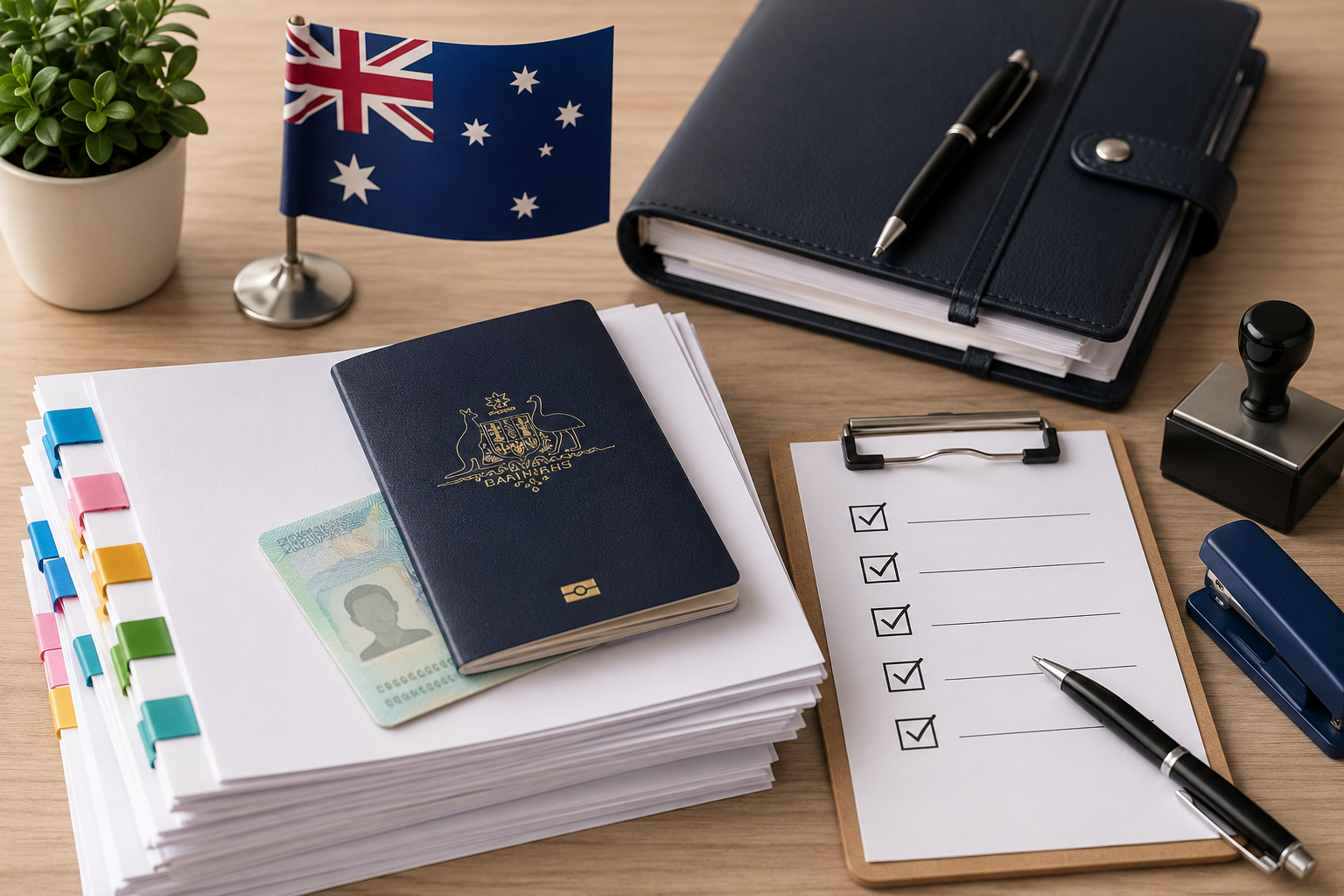
If you are planning to apply for Australian permanent residency through a skilled migration pathway in 2026, having the right paperwork in place is one of the most important parts of the process. A missing document, an expired certificate, or weak employment evidence can slow down your application or even lead to refusal.
This guide gives you a complete Australia PR documents checklist for skilled migrants, including what documents are usually required for visas such as Subclass 189, Subclass 190, and Subclass 491, how to organise them, and what extra documents can strengthen your case.
Australia’s skilled migration program is document-heavy because every claim you make in your Expression of Interest (EOI) and visa application must be backed by evidence. That includes your age, identity, education, work experience, English language ability, skills assessment, relationship status, and character.
For skilled migration applications in 2026, the Department of Home Affairs continues to emphasise decision-ready applications. That means applicants should upload all required documents as early as possible, rather than waiting for the department to request them later. Home Affairs also advises applicants to include detailed employment evidence, police clearances for all relevant countries, English language proof, identity documents for all family members, and a complete residential and travel history.
This checklist is mainly for skilled migrants applying under one of these pathways:
The exact document list can vary slightly depending on your visa subclass, occupation, family situation, and country of residence. Still, the checklist below covers the core documents most skilled PR applicants need in 2026.
Your identity documents are the foundation of your application. You must be able to prove who you are and ensure that all details match across your passport, education documents, employment letters, and skills assessment.
You should also keep:
Before lodging the visa, skilled migrants usually move through several stages:
At the visa stage, keep copies of:
These are not “supporting proofs” in the same sense as your passport or PCC, but they are essential for tracking your application and ensuring consistency between what you claimed and what you uploaded.
A positive skills assessment is one of the most important items in the Australia PR documents checklist. Skilled visas such as Subclass 189, 190 and 491 generally require a valid skills assessment for your nominated occupation.
The exact list depends on your assessing authority, such as VETASSESS, Engineers Australia, ACS, or other relevant bodies, but commonly includes:
Even after you get a positive skills assessment, keep all the supporting evidence used for it. Home Affairs may still expect strong employment and qualification proof with your visa application, especially if your points claim depends on skilled work experience. Home Affairs specifically notes that a work reference alone may not be enough and that detailed employment proof such as bank statements, payslips and tax documents can be important.
You must prove your English proficiency if your visa stream requires points for English or minimum eligibility criteria.
If you are claiming points for Competent English, Proficient English, or Superior English, make sure your test score is still valid on the relevant date for your visa application. Home Affairs also asks skilled applicants to include evidence of English language proficiency with their application.
Your qualifications support both your skills assessment and, in many cases, your migration points.
Keep documents for each level:
Make sure names and dates across transcripts, certificates, passport, and skills assessment documents match exactly.
Employment evidence is often the area where skilled PR applicants face the most scrutiny. If you are claiming points for overseas or Australian skilled work experience, your documentation must be detailed and credible.
Prepare the following for each employer relevant to your claim:
Home Affairs’ current skilled visa guidance explicitly warns that a work reference alone is not enough to prove work history and says applicants should provide detailed employment evidence such as bank statements, payslips, and tax statements.
If your spouse or partner is included in the application, or if you are claiming partner-related points or benefits, relationship evidence becomes important.
Depending on the basis of your claim, you may need:
Character requirements are a standard part of Australian skilled migration.
You generally need police certificates for:
Home Affairs specifically states that skilled visa applicants must provide police certificates for themselves and family members over 16, covering countries where they lived for 12 months in the past 10 years since turning 16.
Most skilled migrants will need to complete health examinations through panel physicians approved by Australia.
Home Affairs advises skilled visa applicants to complete health examinations at the right time and to include the HAP ID where relevant. It also notes that health examination results are generally valid for 12 months.
This is one area many applicants underestimate. You may be asked to provide a full residential and travel history for the last 10 years.
Home Affairs specifically tells skilled visa applicants to declare their full residential and travel history for the past 10 years.
If you are applying through a state or territory nomination pathway, you may need an additional layer of documents beyond the federal visa application.
Depending on the state, documents may include:
Always check the current nomination requirements of the relevant state or territory because these can change independently of the visa rules.
If your spouse, partner, or children are included, build a separate mini-checklist for each person.
A strong Australia PR documents checklist is not just about collecting documents; it is also about presenting them in the correct format.
Prepare:
Depending on the stage and document type, you may need:
| Document Category | Main Documents | Who Needs It | Notes |
|---|---|---|---|
| Identity documents | Passport, birth certificate, national ID, old passports | Main applicant + dependants | Names and dates must match across all records |
| Skills assessment | Positive skills assessment, qualification proof, work evidence | Main applicant, and partner if claiming partner points via skills pathway | Must be valid and relevant to nominated occupation |
| English language proof | IELTS/PTE/TOEFL/OET score report | Main applicant and partner if relevant | Needed for eligibility and/or points claims |
| Education documents | Degree, diploma, transcripts, provisional certificate | Main applicant, sometimes partner | Used for skills assessment and migration evidence |
| Employment documents | Reference letters, payslips, tax records, bank statements, contracts | Main applicant and partner if claiming work-based points | Strong evidence is critical; work reference alone may not be enough |
| Relationship documents | Marriage certificate, joint bills, shared finances, child birth certificates | Married/de facto applicants and families | Important for partner inclusion and partner points |
| Police clearance certificates | PCCs from relevant countries | Adults in the application | Usually needed for all applicants aged 16+ where applicable |
| Health documents | HAP ID, eMedical receipts, medical reports if requested | All applicants as required | Complete at the correct stage of the process |
| Residential/travel history | 10-year address and travel record | Main applicant and often adult dependants | Keep dates consistent with passports and forms |
| State nomination documents | Nomination approval, commitment statements, local evidence | 190/491 applicants only | Depends on state or territory rules |
| Dependant documents | Passport, birth certificate, consent/custody proof, PCC/health docs where relevant | Spouse and children | Create separate folders for each dependant |
| Translation/certification | Certified translations, notarised/certified copies where needed | Anyone with non-English documents | Upload both original and translation where required |
A standard Australia PR documents checklist usually covers the obvious items like passport, IELTS and degree certificates. But in real applications, delays often happen because applicants forget the “supporting evidence behind the evidence.”
Here are the commonly missed documents skilled migrants should prepare in 2026:
Old passports can help prove:
A payslip alone is weaker if it is not supported by salary credits in your bank account. If you are claiming work experience points, keep both.
Tax returns, tax deduction statements, social insurance, provident fund, or pension records can make your employment evidence much stronger.
Many refusals or negative skills assessments happen because the job reference letter is too generic. Your duties should align with the occupation you nominated.
Applicants often struggle to reconstruct a 10-year address history. Build a timeline now, while you still have access to old emails, leases, bank statements and HR records.
If your spouse is included in the application, you may still need identity, PCC, health, and relationship documents. If you are claiming partner points, the documentation requirement becomes even more important.
If your birth certificate, marriage certificate, employment letters or police certificates are not in English, do not wait until the last minute for translation. Translation delays can push back your visa filing.
A practical way to prepare is to create one master folder with subfolders such as:
Inside each folder, use clean file names such as:
This makes it much easier to upload documents into ImmiAccount and cross-check them before submission.
For skilled migrants, document preparation is not a side task; it is one of the core parts of the PR process. A well-prepared Australia PR documents checklist can save weeks of back-and-forth, reduce the risk of refusal, and help you lodge a decision-ready application.
At a minimum, focus on these six pillars:
Then add spouse, dependant, state nomination, translation, and travel-history documents as needed for your case.
Because document requirements can vary by visa subclass and personal circumstances, always cross-check your final list against the official Department of Home Affairs visa page for your subclass and the step-by-step “gather your documents” section before you lodge. Home Affairs’ skilled visa guidance for 2025–2026 also stresses that complete applications with health, character, and skills evidence are important for smoother processing.