
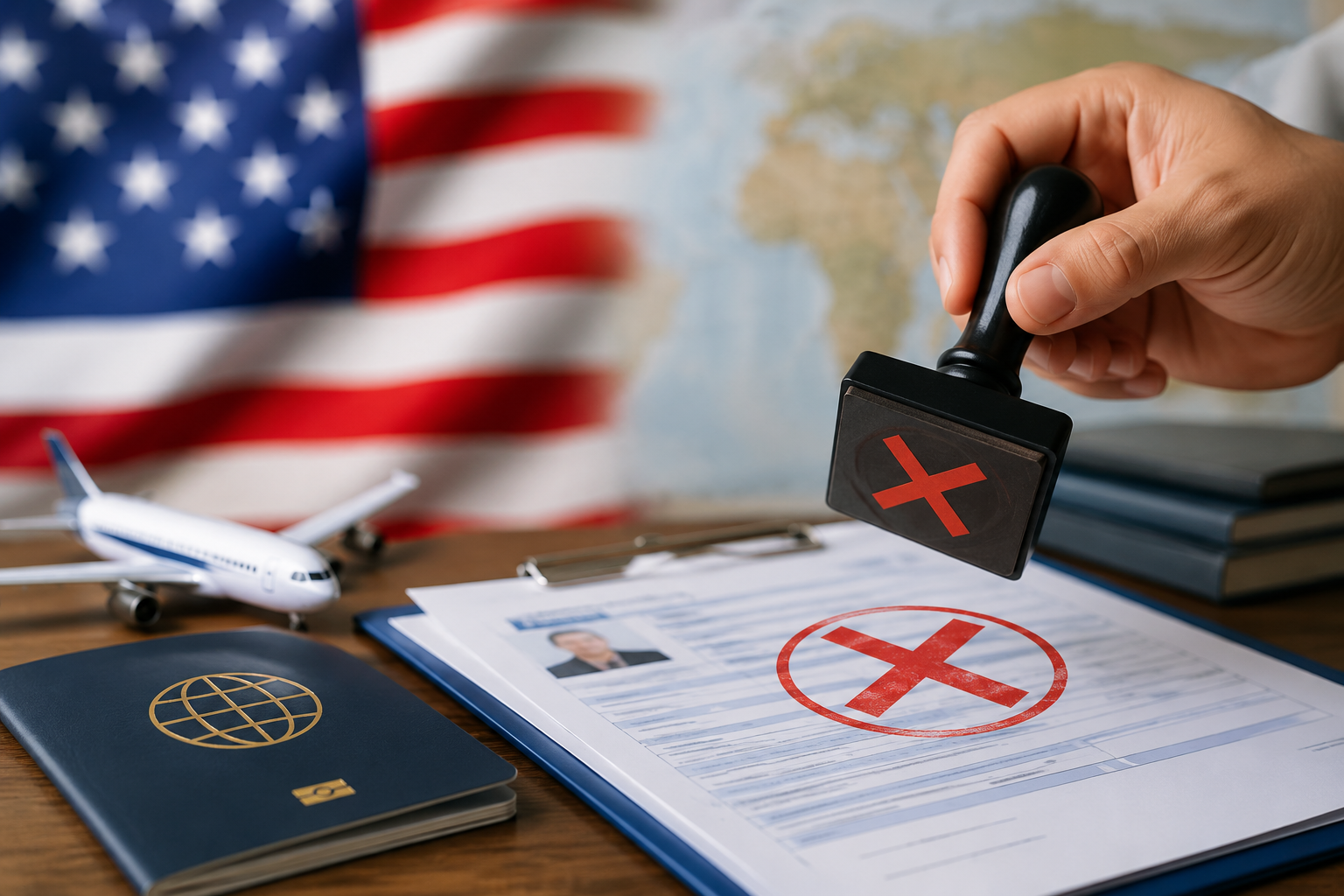
Applying for a USA visit visa can be an exciting step when planning a holiday, visiting family or attending business meetings in the United States. However, not every B1/B2 visa application is approved.
Many applicants are surprised when their visa is refused after a short interview. A refusal can occur when a consular officer determines that an applicant has not established eligibility for the requested nonimmigrant visa.
Understanding common B1 B2 visa rejection reasons can help applicants prepare their application carefully and avoid preventable mistakes.
In this guide, we discuss 10 common USA visit visa rejection reasons, mistakes applicants should avoid and practical points to consider before attending a US visa interview.
The B1/B2 visa is a nonimmigrant visitor visa for temporary travel to the United States.
The B1 category generally covers certain temporary business activities, while the B2 category is commonly associated with tourism, holidays, visiting family or friends and certain other temporary visitor purposes.
Applicants must demonstrate that their intended travel is temporary and that they qualify for the visitor visa category.
A visa application is assessed individually. Approval is never guaranteed simply because an applicant has sufficient funds, a US-based relative or a previous international travel history.
| Common Mistake | Why It May Create Concern | What Applicants Should Do |
|---|---|---|
| Unclear travel purpose | The purpose of the US trip is not convincing | Clearly explain the reason for travel |
| Weak home-country ties | Concerns about returning after the visit | Be prepared to explain genuine personal and professional circumstances |
| Inconsistent answers | Interview answers conflict with the DS-160 | Review the application before the interview |
| Incorrect information | Errors may affect credibility | Provide accurate and truthful details |
| Financial concerns | Travel plans do not appear financially realistic | Understand the expected trip cost and funding |
| Poor interview preparation | Applicant cannot explain basic travel details | Review the itinerary and application |
| Suspicious travel plans | Duration or itinerary appears unrealistic | Create a genuine and practical travel plan |
| Previous immigration issues | Past violations may affect eligibility | Disclose immigration history accurately |
| Depending only on a sponsor | Applicant cannot explain personal circumstances | Clearly explain the funding arrangement and overall situation |
| False documents or statements | Can lead to serious immigration consequences | Never provide fraudulent or misleading information |
One of the most common B1 B2 visa rejection reasons is an unclear or poorly explained travel purpose.
The visa officer may ask:
Why do you want to visit the United States?
Where will you stay?
How long will you remain in the USA?
What places are you planning to visit?
Applicants should be able to explain their travel plans clearly and naturally.
For example, saying, “I just want to visit America,” may provide very little information about the intended trip.
A clearer explanation may include the purpose of the visit, expected travel period and planned destinations.
Your answers should always reflect your genuine travel plans.
Do not create an artificial travel story simply because you think it sounds more convincing. The purpose mentioned during the interview should be consistent with the information in your visa application.
A B1/B2 visa is intended for temporary travel.
Under US immigration law, many nonimmigrant visa applicants are subject to the presumption of immigrant intent under Section 214(b) of the Immigration and Nationality Act. The applicant must establish eligibility for the requested nonimmigrant status.
This is why the applicant’s circumstances outside the United States can be important.
Relevant circumstances may include:
There is no single document that automatically proves an applicant will return home.
The consular officer considers the application and circumstances of the individual applicant.
Do not assume that property ownership alone guarantees visa approval. An applicant’s overall circumstances are considered.
Inconsistency is another important issue among B1 B2 visa rejection reasons.
The DS-160 contains important information about an applicant’s personal details, employment, travel plans and background.
Problems may arise when interview answers significantly conflict with information provided in the application.
For example:
| DS-160 Information | Interview Answer | Possible Issue |
| Tourism | Visiting for business meetings | Different travel purpose |
| 10-day trip | Planning to stay for three months | Major duration difference |
| Self-funded | Relative paying for everything | Funding inconsistency |
| Employed | Says currently unemployed | Employment inconsistency |
Some circumstances can genuinely change after a DS-160 is completed. However, applicants should answer truthfully and explain genuine changes when appropriate.
Review your DS-160 information before attending the interview. Do not memorise fake answers. Simply understand the information you submitted.
Providing false information is one of the most serious visa application mistakes.
Some applicants believe changing their employment details, income, marital status, relatives in the United States or previous visa history will improve their chances.
This can create significant immigration consequences.
Willful misrepresentation of a material fact or fraud may result in visa ineligibility and, depending on the legal ground involved, can have long-term or permanent consequences.
Applicants should provide accurate information about:
Never submit fake bank statements, employment letters, invitations or other fraudulent documents.
Truthful information is essential throughout the visa process.
Financial circumstances can be relevant to a visitor visa application.
The officer may consider whether the proposed travel plan appears realistic based on the applicant’s situation and the stated funding arrangements.
Applicants should understand:
Who is paying for the trip?
What is the expected duration?
Where will the applicant stay?
What are the approximate travel expenses?
If another person is funding the trip, the applicant should clearly understand and truthfully explain the relationship with that person and the funding arrangement.
An applicant states that they earn a modest monthly income but plans a six-month luxury holiday without clearly explaining the funding arrangement.
Such a travel plan may raise additional questions.
Do not suddenly deposit large amounts of borrowed money into a bank account solely to create an artificial financial picture.
Financial information should reflect genuine circumstances.
The US visa interview can sometimes be brief. Applicants should therefore be prepared to answer straightforward questions clearly.
Common questions may relate to:
Poor preparation does not mean applicants should memorise scripted answers.
In fact, overly rehearsed responses can sound unnatural.
Do not learn answers from another applicant and repeat them word for word.
Every applicant has different circumstances. Your answers should be based on your own application and genuine travel plans.
An unrealistic itinerary can raise questions about the genuine purpose of travel.
For example, a first-time tourist may claim they will visit 15 US cities in seven days.
Another applicant may request a very long stay without being able to explain how they can remain away from their employment or business for that period.
A practical itinerary should consider:
Do not create an unnecessarily complicated itinerary to impress the visa officer.
Simple, realistic and genuine travel plans are easier to explain.
Previous visa refusals or immigration issues should not be hidden when the application asks for this information.
Relevant history may include:
A previous visa refusal does not automatically mean every future application will be refused.
However, applicants should answer application questions truthfully.
Understand the refusal information provided to you and consider whether your circumstances or relevant evidence have materially changed before submitting another application.
Simply submitting the same application repeatedly may not resolve the underlying concern.
Never hide a previous visa refusal when the application specifically asks about it.
Many applicants believe an invitation letter from a US citizen or permanent resident guarantees visa approval.
It does not.
A sponsor, relative or host may help explain the purpose of the visit or funding arrangement. However, the visa officer still assesses whether the individual applicant qualifies for the requested visa.
Applicants should be prepared to explain:
Do not answer every interview question by saying, “My sponsor knows everything.”
You are the visa applicant and should understand your own travel plans.
Visa interviews can make applicants nervous. Nervousness itself does not necessarily mean a visa will be refused.
However, repeatedly changing answers or providing contradictory information can affect the assessment of the application.
For example:
Visa Officer: How long will you stay?
Applicant: Two weeks.
Later:
Visa Officer: When will you return?
Applicant: Maybe after three or four months.
Such significant inconsistencies may raise questions about the actual travel plan.
Listen carefully to each question and answer truthfully.
If you do not understand a question, it is better to politely ask for clarification rather than guess.
One additional mistake deserves special attention: reapplying immediately after a visa refusal without understanding what has changed.
Applicants sometimes submit a new DS-160 and book another appointment soon after a refusal while presenting substantially the same circumstances.
If the earlier refusal was under Section 214(b), applicants may reapply. However, a new application does not automatically produce a different decision.
Before reapplying, consider:
What were your circumstances at the time of the previous application?
Has anything relevant changed?
Can you explain your travel purpose more clearly and truthfully?
Was important information incorrect or inconsistent?
Are you applying for the correct visa category?
Reapplying should be a considered decision rather than an emotional reaction to a refusal.
| Interview Mistake | Better Approach |
| Giving very long answers | Answer the question clearly and directly |
| Memorising scripted answers | Speak naturally and truthfully |
| Hiding US relatives | Provide accurate information |
| Changing the travel purpose | Remain consistent with genuine plans |
| Guessing information | Explain honestly if you do not know |
| Providing fake documents | Submit only genuine information |
| Arguing with the officer | Remain professional and respectful |
| Giving contradictory dates | Review travel plans before the interview |
| Depending entirely on an agent | Understand your own application |
| Making exaggerated claims | Provide accurate facts |
Applicants can reduce avoidable errors by preparing carefully.
Before submitting or attending an interview:
Good preparation cannot guarantee visa approval. However, it can help applicants avoid common mistakes and present accurate information clearly.
Not every B1/B2 visa refusal is permanent.
The effect of a refusal depends on the legal basis for the decision.
For example, a refusal under Section 214(b) is different from certain statutory ineligibilities involving fraud, misrepresentation or other grounds.
Applicants should carefully review any refusal information provided by the US Embassy or Consulate.
If the immigration history or refusal ground is complicated, obtaining advice from an appropriately qualified US immigration lawyer may be useful.
In many situations, an applicant can submit a new visa application after a refusal.
However, applicants should understand that reapplying normally involves completing the applicable visa application process again.
Before reapplying, review your previous application and current circumstances.
Ask yourself:
Why am I travelling to the United States?
Can I clearly explain my temporary travel plans?
Is my DS-160 information accurate?
Have my relevant circumstances changed?
Am I prepared to answer questions consistently?
The objective should not be to invent a “stronger story.” The objective is to submit accurate information and clearly explain genuine circumstances.
Section 214(b) is a commonly discussed basis for nonimmigrant visa refusals. It generally relates to an applicant not establishing eligibility for the requested nonimmigrant visa under the applicable legal standard.
There is no universal bank balance that guarantees B1/B2 visa approval. The applicant’s travel plans, financial circumstances and overall application may be considered.
Applicants should answer questions accurately. If language support or local interview procedures are available, applicants should follow the instructions of the relevant US Embassy or Consulate.
Having relatives in the United States does not automatically result in a visa refusal. Applicants should provide truthful information when asked about relatives and their travel purpose.
Depending on the refusal ground, reapplication may be possible. Applicants should review the refusal information and understand their circumstances before submitting a new application.
No. An invitation letter does not guarantee visa approval. The consular officer determines whether the applicant qualifies for the requested visa.
No. Applicants should answer visa application questions accurately and truthfully.
Understanding common B1 B2 visa rejection reasons can help applicants avoid preventable errors during the USA visit visa application process.
An unclear travel purpose, inconsistent DS-160 information, unrealistic travel plans, misleading statements and poor interview preparation can create problems during a visa assessment.
The most important approach is to provide truthful information, understand your own application and clearly explain your genuine temporary travel plans.
No consultant, sponsor, invitation letter or interview script can guarantee USA visit visa approval. Every application is assessed based on the applicant’s circumstances and applicable US immigration law.
Disclaimer: This article is for general informational purposes only and does not constitute legal or immigration advice. Visa requirements, procedures and individual circumstances may vary. Applicants should check current guidance from the US Department of State and the relevant US Embassy or Consulate before applying.